
Digital Business Cards for Lead Generation: A Complete Guide
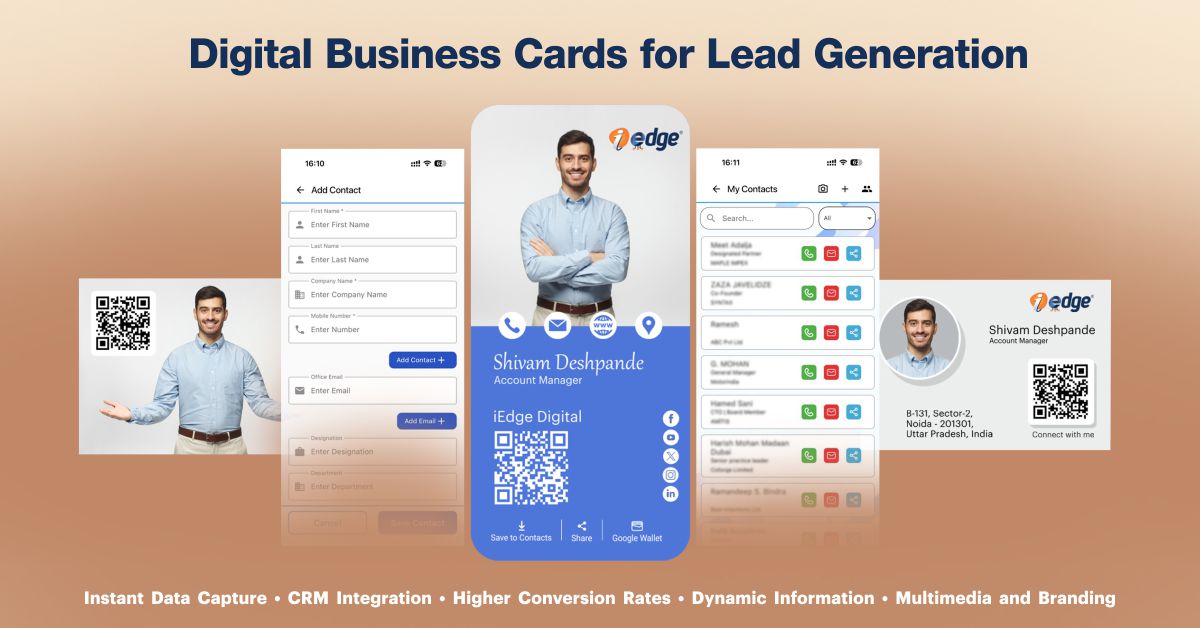
If you want to generate leads consistently in today’s competitive market, traditional networking methods are no longer enough. We have worked with founders, sales heads, and marketing leads, and one pattern is clear. Paper cards get exchanged. Conversations happen. Follow up rarely. This gap between meeting and meaningful conversion is where most businesses lose opportunities. In board rooms, trade shows, B2B expos, and investor meets, we have seen companies invest heavily in branding but still struggle with actual pipeline creation. The question is no longer whether networking works. The question is how to convert networking into measurable revenue. This is where digital business cards for lead generation completely change the game. This blog will give you a complete overview of lead generation using a digital business card.
Why Lead Generation is Important?g
Before discussing tools, we must first understand the foundation. Lead generation is not a marketing tactic. It is the lifeline of predictable revenue growth. Companies and teams that focus on structured lead acquisition outperform competitors by a large margin. Here is why:

1. Revenue Predictabilityy
Without a consistent system to generate leads, forecasting becomes guesswork. A healthy pipeline allows leadership teams to project revenue with confidence.
Learn how to make digital business cards for your personal branding.
2. Scalable Growth
When you master B2B lead generation, you stop depending on referrals alone. You build repeatable systems that scale across regions and markets.


3. Reduced Sales Friction
High-quality leads shorten the sales cycle. Sales teams spend more time closing and less time chasing.
4. Data-Driven Decisions
Modern lead acquisition provides insights. You learn which campaigns convert. Which industries respond? And which decision makers engage?


5. Competitive Advantage
Companies that understand how to get leads efficiently dominate trade events, conferences, webinars, and networking forums.
Over the past decade, we have observed that different stagnant companies and high-growth companies are not equal. It is a process. And the process begins with a clear lead generation guide backed by technology.
Create your professional presence with iEdge.
Why Use a Digital Business Card for Lead Generation?
Traditional business cards create visibility. They do not create systems. Modern digital business cards for lead generation bridge the gap between meeting someone and moving them into your sales pipeline automatically. Let us break down why this shift matters.

1. Instant Data Capture
At conferences and networking events, time is limited. Manual note-taking results in errors and lost context. With a digital card, contact details are captured instantly. No manual entry. No lost cards.
This has helped sales teams increase qualified contacts by over 40% at exhibitions when switching from paper cards to digital capture. When your goal is to generate leads, speed matters. Real-time data collection gives you a first-mover advantage in follow-ups.
2. CRM Integration
This is where transformation happens. Traditional networking creates a pile of business cards on your desk. Digital systems sync directly into CRM platforms like Salesforce or HubSpot. The moment someone shares their details, they are added to your pipeline.
Tags can categorize industry, interest, or event source. For organizations focused on B2B lead generation, this automation removes friction between marketing and sales. It also aligns perfectly with a structured lead generation guide built around measurable KPIs.

3. Higher Conversion Rates
When prospects receive an interactive card instead of paper, engagement increases. Clickable links, meeting booking buttons, product demos, and case studies.
We have observed that companies that actively generate leads with digital business card tools see better response rates simply because prospects can act immediately. Convenience drives conversion.
4. Dynamic Information
Executives change roles. Phone numbers are updated. The product line evolves. With paper cards, outdated information remains in circulation. With digital cards, updates reflect instantly. This keeps your brand accurate and professional.
For companies exploring how to get leads across multiple campaigns, this flexibility is critical.


5. Multimedia and Branding
Your digital card can host company introduction videos, brochures, portfolio links, testimonials, and Calendly integration. This transforms a simple contact exchange into a micro landing page experience.
When designed strategically, digital business cards for lead generation become conversion assets rather than static contact files.
Key Features for Lead-Generating Digital Business Card
Over the years, we have evaluated dozens of platforms. The most effective solutions share common technical capabilities.
1. NFC and QR Codes
Executives change roles. Phone numbers are updated. The product line evolves. With paper cards, outdated information remains in circulation. With digital cards, updates reflect instantly. This keeps your brand accurate and professional.
For companies exploring how to get leads across multiple campaigns, this flexibility is critical.


2. Lead Capture Forms
A powerful digital business card does more than just display information. It collects it. Embedded lead forms allow you to ask qualifying questions such as company size, budget range, service interest, and decision-making authority.
This supports intelligent B2B lead generation because not all contacts are equal. Structured forms transform casual networking into data-driven prospecting.
3. Analytics and Tracking
Without analytics, there is no optimization. Modern platforms show the number of profile views, click-through rates, link engagement, and geographic insights. These metrics help refine your approach. When executives ask how to improve networking ROI, analytics provide the answer.
They help you understand how to get leads more efficiently over time. As per our observation, companies that track engagement improve conversions within two quarters because they adapt based on real behavior.

Best Practices for Lead Generation
Technology alone is not enough. Execution matters. Here are proven strategies that we recommend to leadership teams implementing digital business cards for lead generation.
1. Define Goals
Start with clarity. Are you targeting enterprise clients, channel partners, or investors? Your messaging must reflect your objective. If your aim is aggressive B2B lead generation, your digital card should highlight case studies, ROI metrics, and enterprise solutions.
A clear objective aligns your networking conversations with measurable results. Study how digital cards help in contact enrichment.


2. Ensure Complete Information
Incomplete profiles reduce credibility. Your digital card must include a professional headshot, company description, contact information, social proof, and a direct call to action.
When companies askus for a practical lead generation guide, we emphasize credibility first. Decision makers engage when they see authority and clarity.
3. Automate Follow Ups
Speed wins deals. Set automated email sequences triggered after contact capture. For example:
- Day 1: Thank you message
- Day 3: Case study
- Day 7: Demo invitation
Automation helps you consistently generate leads without relying on memory. This is especially powerful when multiple team members attend large events.

4. Use Dynamic QR Codes
Static QR codes limit adoptability. Dynamic codes allow content updates, tracking, and campaign customization. For organizations serious about learning how to get leads from different audience segments, dynamic codes offer flexibility and data. You can even create event-specific landing experiences.
5. Utilize Analytics
Review performance weekly. Ask critical questions like: Which event delivered the most scans? Which call to action had the highest click rate? Which industry segment engaged the most?
The analytical approach strengthens your lead generation guide and improves quarterly results. We have seen companies double networking ROI simply by adjusting their call to action based on scan behavior.

Strategic Implementation for Leadership Teams
From a leadership perspective, adoption must be structured.
- Train your sales team on positioning.
- Integrate digital cards into CRM workflows.
- Standardize branding across departments.
- Monitor KPIs such as contact capture rate and follow-up speed.
When done correctly, digital business cards for lead generation become part of your revenue engine, not just a networking accessory. Executives often ask whether this works for enterprise deals.
The answer is Yes. In high-value B2B transactions, credibility and speed are crucial. A digital ecosystem that helps you generate leads and nurture them systematically increases deal velocity.
Find out the top 5 digital business cards for students.
The Future of Networking and B2B Lead Generation
Networking is evolving. Decision makers expect instant access to information. They prefer frictionless communication. Companies that still rely on printed cards will struggle to compete with tech-enabled brands.
Forward-thinking organizations already use digital business cards for lead generation as part of broader digital transformation initiatives. The most successful teams combine:
- Digital identity
- Automated CRM workflows
- Data-driven insights
- Consistent follow-up strategy
Conclusion
Networking alone does not build pipelines. Systems do. If your organization wants predictable growth, measurable ROI, and stronger conversion from events and meetings, adopting digital business cards for lead generation is no longer optional.
Over the years, companies have transformed their networking outcomes by replacing manual exchanges with intelligent digital systems. They capture contacts instantly. They analyze engagement. They automate follow-ups. Most importantly, they consistently generate leads that convert into revenue.
For businesses that are serious about building scalable acquisition engines, this approach aligns perfectly with a structured lead generation guide. The market is competitive. Attention spans are short. Opportunities move fast. Modern leaders do not ask whether digital transformation is necessary. They ask how quickly they can implement it.
If you want clarity on how to get leads in a measurable, professional, and scalable way, the answer is clear. Move beyond paper. Adopt intelligent digital systems. Use data. Act fast. This is how high-growth companies win.
FAQs
Digital business cards are smart contact sharing tools that allow professionals to exchange details through QR codes, NFC taps, or links. Unlike traditional cards, they help companies generate leads by capturing contact data instantly and directing prospects to landing pages, forms, or booking links.
Businesses use digital business cards for lead generation because they convert simple networking moments into trackable opportunities. When someone scans the card, companies can collect information, monitor engagement, and start follow-ups immediately.
This makes them an effective lead generation guide for modern networking, especially for organizations focused on B2B lead generation and professionals exploring how to get leads from events, meetings, and conferences.
A digital business card designed to generate leads should include tools that capture, track, and convert contacts. Strong digital business cards for lead generation usually include QR codes or NFC sharing, lead capture forms, and CRM integration.
Analytics is another critical feature because it shows who viewed or interacted with the card. Multimedia elements such as product links, brochures, or meeting booking options also improve engagement.
These features help organizations follow a practical lead generation guide while supporting strong B2B lead generation strategies. When businesses understand how to get leads, they often choose platforms that allow teams to generate leads with digital business card tools while monitoring performance in real time.
Companies are moving toward digital solutions because they want faster and more measurable ways to generate leads. Traditional cards often get lost or forgotten, while digital business cards for lead generation capture data instantly and allow direct follow-ups.
Businesses can also track interactions, update information anytime, and link their profiles to marketing assets. This makes networking more productive for teams focused on b2b lead generation.
Many organizations now include these tools in their lead generation guide because they help convert meetings into opportunities. For leaders exploring how to get leads from conferences or industry events, the ability to generate leads with digital business card technology offers a clear advantage.
Yes, many digital business cards for lead generation integrate directly with CRM platforms like HubSpot or Salesforce. This integration allows companies to generate leads and automatically store contact data in their sales pipeline.
Once a prospect scans the card or submits a form, the information moves into the CRM system without manual entry. This supports organized B2B lead generation because sales teams can categorize contacts, assign follow-ups, and track interactions.
Businesses that want a structured lead generation guide rely on this automation to manage networking contacts effectively. For companies learning how to get leads, CRM integration also makes it easier to generate leads with digital business card tools at scale.
Successful b2b lead generation with digital cards begins with clear goals and a structured process. Companies that want to generate leads should include complete professional information, strong branding, and a clear call to action on their digital profiles.
High-performing digital business cards for lead generation also include lead capture forms and meeting booking options. Automation is another best practice because quick follow-ups increase conversion rates.
Analytics should be reviewed regularly as part of a broader lead generation guide. When teams understand how to get leads from networking events, they can consistently generate leads with digital business card systems and turn conversations into real sales opportunities.