
Digital Identity Management Across Teams and Business Units
Digital identity management has become a critical priority for organizations operating across multiple teams and business units. As enterprises scale, identities of employees, partners, and customers are scattered across systems, creating gaps in trust, visibility, and control.
The result is slower onboarding, higher security risk, and inconsistent user experiences. According to the IBM Cost of a Data Breach Report 2023, compromised identities remain one of the leading causes of data breaches, with the global average breach cost reaching $4.45 million. Gartner also highlights that weak identity governance is a growing enterprise risk. These realities highlight why businesses need a structured approach to managing digital identities.
This blog will explore what digital identity management is, the problems organizations face, its key components, business benefits, and how digital business cards can support identity management across teams and business units.
What is Digital Identity Management?
Digital identity management refers to the framework, processes, and technologies used to create, verify, manage, and govern digital identities across systems and stakeholders. A digital identity represents a person, employee, contractor, or partner in digital form.
It includes verified attributes such as name, role, organization, credentials, and permissions. Unlike traditional identity records stored in isolated databases, modern digital identity management focuses on portability, trust, and real-time control.
Identities are not static entries. They evolve as roles change, access rights update, and affiliations shift.
Example
Consider a multinational enterprise onboarding a new regional sales head. With digital identity management, the individual’s verified identity is created once. That identity can be used across HR platforms, CRM systems, internal collaboration tools, partner portals, and customer-facing interactions.
Know the iedge digital business card feature for your brand.
When the role changes or the person exits, access and credentials are updated or revoked centrally. There is no manual chasing across systems. In this way, digital identity management supports scale, governance, and user experience at the same time.
The Problem
Despite increased awareness, many organizations still struggle with identity challenges. These issues become more visible as businesses grow across teams and business units.
Digital Onboarding and Identity Verification
Digital onboarding often involves repetitive form-filling, document uploads, and manual checks. New hires or partners experience delays before they become productive. Errors during digital identity verification create compliance risks and operational bottlenecks.
Without a unified approach, onboarding teams rely on emails, spreadsheets, and disconnected tools. This leads to inconsistent identity data and weak audit trails.
IAM Environments
Identity and Access Management systems focus heavily on access control. While IAM platforms are powerful, they often treat identity as a backend object rather than a living digital credential. Business context, such as role visibility, verified attributes, and external sharing, is limited.
This creates a gap between identity governance and real-world usage. Teams struggle to align identity records with how people actually interact across departments and channels.
Learn how iedge helps agent onboarding in real estate.
Call Centers
Call centers face identity challenges every day. Agents must verify customers quickly without adding friction. Knowledge-based questions and one-time passwords are still widely used, even though they are vulnerable to social engineering.
Poor digital identity verification in call centers increases average handling time and lowers customer trust. It also exposes organizations to fraud and accounts for takeover risks.
AI-Driven Environments
AI-driven systems rely heavily on accurate identity data. Whether it is automated decision making, personalization, or risk scoring, identity signals must be trustworthy. When identities are incomplete or outdated, AI outcomes suffer.
In such environments, digital identity management becomes a foundation for reliable automation. Without it, AI amplifies existing data issues rather than solving them.
Key Components of Digital Identity Management
A robust digital identity management framework is built on several core components. Each plays a specific role in establishing trust and control.
Identity Verification
Identity verification is the starting point. It validates that a person is who they claim to be. This may involve document checks, biometric validation, or authoritative data sources. Strong digital identity verification reduces fraud and supports regulatory compliance. It also builds confidence across teams that identity data can be trusted.
Know how to utilize an AI-powered business card capture lead.

Issuance of Verifiable Credentials
Once verified, identities are issued as verifiable credentials. These credentials are cryptographically secure and tamper-resistant. They can represent employment status, role, certifications, or permissions.
Verifiable credentials allow organizations to share proof without exposing unnecessary data. This principle supports privacy and data minimization.
Wallets
Digital wallets store verifiable credentials. These wallets may be cloud-based, embedded within enterprise applications, or standalone apps controlled by the user. Wallets give individuals visibility and control over their digital ids.
For organizations, wallets act as secure containers that support portability across platforms and business units.


Verification Requests
Verification requests allow third parties to validate credentials in real time. Instead of copying documents or screenshots, a verifier sends a request that checks authenticity instantly. This capability is critical for cross-team collaboration, partner access, and customer interactions where speed and trust matter.
Find out the top digital business card for students.
Revocation and Lifecycle Management
Identities change over time. Roles evolve; contracts end, and permissions expire. Lifecycle management handles these changes through updates and revocation. Effective digital identity management supports real-time revocation. When an employee leaves, access and credentials are invalidated immediately across systems.


Biometrics and Binding
Biometrics bind a digital identity to a real person. Fingerprints, facial recognition, or voice patterns add a strong layer of assurance. When used responsibly, biometrics strengthen identity binding and reduce impersonation risks, especially in remote and high-risk interactions.
Benefits of Implementing Digital Identity Management
The value of digital identity management extends beyond security. It delivers measurable business outcomes across the organization.
Enhancing Employees’ User Experience
Employees interact with identity systems from day one. A unified identity experience reduces friction during onboarding, role changes, and daily access. With a single trusted digital identity, employees spend less time dealing with access issues and more time on productive work. This improves engagement and satisfaction.


Higher Levels of Accuracy
Manual identity processes introduce errors. Duplicate records, outdated roles, and inconsistent data create confusion. Digital identity management improves accuracy by maintaining a single source of truth. Verified attributes and automated updates reduce human error and improve data quality across systems.
Discover why professional networking matters in the corporate world.
Improve Customer Experience
Customers expect fast and secure interactions. Whether it is account access, support calls, or digital transactions, identity plays a central role. Strong digital identity verification shortens verification steps and builds trust. Customers feel confident when organizations handle identities professionally and transparently.


Reduces Costs and Increases Efficiency
Operational inefficiencies around identity are expensive. Manual onboarding, access resets, and fraud incidents consume time and resources. Digital identity management reduces these costs by automating verification, credential issuance, and lifestyle events. Teams operate faster with fewer dependencies and lower risk of exposure.
How Digital Business Cards Act as Digital Identity Management Tools
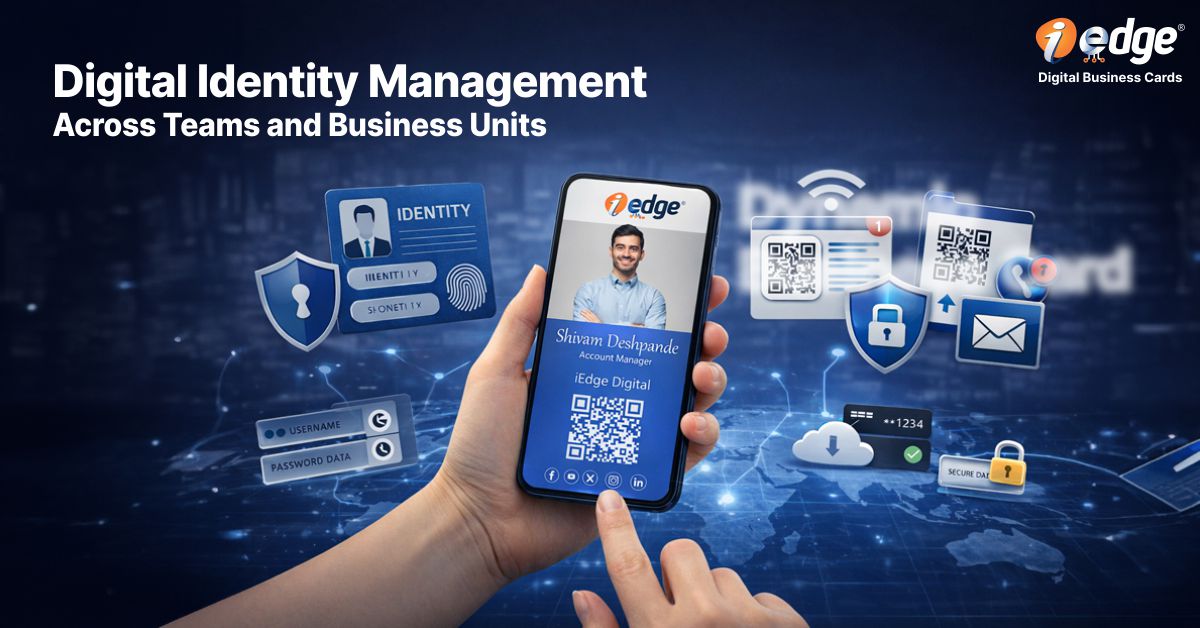
A digital business card is often viewed as a modern networking asset. In reality, it can function as a lightweight and effective digital identity management layer, especially across teams and business units.
Verified Professional Identity
A digital business card represents a verified professional identity. It includes name, role, organization, and contact details that are controlled centrally. When issued by the organization, the digital business card becomes an extension of digital IDs used internally. It reflects current roles and affiliations in real time.
Learn how digital cards help in contact enrichment.
Real Time Updates Across Teams
As employees move across teams or business units, their digital business card updates instantly. There is no need to reprint or redistribute information. This dynamic nature supports organizations that want to know how to get a dynamic profile without adding operational burden.


Controlled Sharing with External Stakeholders
Employees share their digital business card with clients, partners, and vendors. Each interaction becomes a verified identity touchpoint. This approach reduces impersonation risks and supports consistent brand representation across markets.
Integration with Identity Management Tools
Modern digital business card platforms integrate with identity management tools and HR systems. This integration aligns employee lifecycle events with identity updates. When an employee exits, access and card visibility can be revoked. This supports lifecycle governance without manual intervention.

Supporting Digital Identity Verification
A digital business card can act as a front-facing identity credential. QR codes, secure links, and verification layers allow recipients to confirm authenticity. This capability supports digital identity verification during meetings, events, and remote interactions.
Know how to create your professional online presence with iedge.
Enabling Dynamic Profiles
Organizations often ask how to create a dynamic profile with a digital business card that reflects changing roles and responsibilities. Digital business cards solve this by linking identity attributes to a centralized profile. This dynamic profile approach supports consistency across internal and external touchpoints.


Scalable Across Business Units
Digital business cards scale easily. Whether an organization has fifty employees or fifty thousand, issuing and managing cards remains consistent. This scalability makes the digital business card a practical entry point into broader digital identity solutions, especially for sales, leadership, and partner-facing teams.
Conclusion
As organizations grow more distributed and digital-first, identity becomes a strategic asset rather than a backend function. Digital identity management provides the structure needed to manage trust across teams, systems, and business units.
By addressing verification, credential issuance, lifecycle control, and user experience, organizations reduce risk and improve efficiency. The business impact spans security, operations, and customer trust.
A digital business card adds a practical layer to this ecosystem. It brings digital IDs into everyday interactions and supports identity consistency beyond internal systems. Investing in digital management is no longer optional. It is a foundation for secure growth, trusted interactions, and future-ready operations.
FAQs
Digital identity management focuses on verified identities, credentials, and lifecycle control across teams and channels. Traditional IAM mainly manages access permissions within systems. Digital identity management adds portability, digital identity verification, and real-time updates. It supports external sharing, digital IDs, and broader governance beyond internal access control.
Yes. Digital identity management accelerates onboarding through automated digital identity verification and credential issuance. New hires receive verified digital IDs faster, with immediate access aligned to roles. This reduces manual checks, errors, and dependency on multiple identity management tools.
Digital IDs provide accurate and verified identity data for AI systems. This improves decision-making, personalization, and automation outcomes. With trusted digital identity management, AI-driven environments rely on consistent identity signals rather than fragmented or outdated records.
A digital business card integrates via APIs with HR systems and identity management tools. It reflects verified identity attributes, role changes, and lifecycle updates in real time. This makes the digital business card a usable extension of enterprise digital identity solutions.
Industries with high compliance, scale, or customer interaction benefit most. These include IT services, BFSI, healthcare, telecom, manufacturing, and enterprise sales organizations. Digital identity management supports secure operations, trusted interactions, and efficient identity governance across business units.