
How Smart Business Card Supports Remote and Hybrid Workforce
A smart business card has quietly become a critical tool for companies managing a hybrid workforce in today’s distributed business environment. Over the last decade, I have watched organizations struggle with broken communication loops, inconsistent branding, lost leads, and outdated contact data as teams shifted away from traditional offices.
The rise of flexible work models is no longer a trend. According to a McKinsey Global Institute report, more than 58% of employees globally have the option to work at least one day a week, while 35% work in hybrid models.
Gartner also reported that hybrid work is now the default model for knowledge-based organizations. These shifts exposed a simple but costly gap. Business networking tools were never designed for remote or hybrid operations.
Paper cards fail instantly in virtual meetings. Static PDFs go outdated. Sales, HR, and Leadership teams lose visibility. From my own experience working with mid-sized firms, global enterprises, and fast-growing startups, smart business cards emerged as one of the most practical solutions for managing a hybrid workforce without operational friction.
This blog shares why deploying smart business cards across your remote or hybrid workforce is a smart choice. Also, we will walk through how they support remote and hybrid teams, the real benefits companies gain, and the technologies shaping their future role in hybrid workforce management.
Learn why a QR code digital business card is better than paper cards.
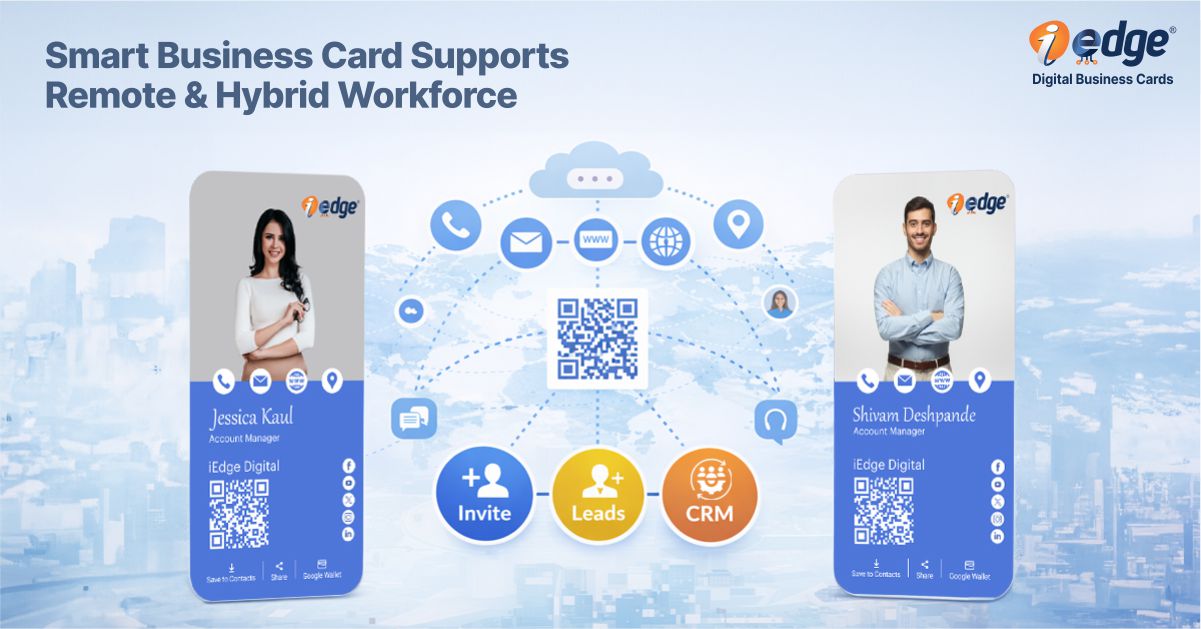
How Smart Business Card Supports Remote and Hybrid Workforce
Over the years, we have seen many tools promise collaboration and visibility. Very few actually deliver at scale. Smart business cards work because they solve real operational problems faced by companies managing remote workforce and hybrid teams.
Instant Sharing Virtual and In-Person
One of the first problems remote teams face is delayed or missed follow-ups. In physical offices, employees exchange cards naturally. In virtual meetings, that habit disappears. Smart business cards restore lost interaction.
You can use them in Zoom calls, LinkedIn outreach, client demos, trade shows, and internal onboarding sessions. With a single link, QR code scan, or NFC tap, contact details are shared instantly.
For hybrid workforce teams, this matters because interactions happen everywhere. Sales executives meet clients on-site. Product teams attend conferences. HR leaders host virtual hiring drives. Smart business cards allow instant sharing in every scenario without friction.
This instant accessibility is foundational for managing remote workforce operations where time gaps often kill momentum.
Know how digital business cards act as a marketing tool.


Real-Time Dynamic Updates
One issue I repeatedly observed with traditional cards was outdated information. Job roles change. Phone numbers change. Teams restructure. Printed cards become obsolete overnight. Smart business cards solve this with real-time updates.
When an employee updates their profile once, the change reflects everywhere. No reprints, no confusion. In hybrid workforce management, consistency is critical. Leadership teams want brand control. Sales teams want accuracy.
Remote teams want simplicity. Smart business cards align with all three. You can cut down internal update requests by more than half after switching to smart business cards.
CRM and Lead Generation Integration
Remote selling depends heavily on data flow. Leads lost during virtual networking never come back. Modern smart business cards integrate directly with CRMs like HubSpot, Sugar, Salesforce, Zoho, and internal sales systems.
Every scan, click, or save becomes a recorded interaction. This integration transforms networking from a passive activity into an active revenue channel. Sales leaders gain visibility. Marketing teams gain attribution. Business owners gain clarity.
For organizations managing a hybrid workforce, this visibility bridges the gap between remote engagement and measurable outcomes.
Discover how a digital business card is the perfect fit for consultants, finance, and legal advisors.


Sustainability and Cost Efficiency
We have worked with enterprises that spent millions annually printing and reprinting cards across regions. The waste was significant. Smart business cards eliminate recurring printing costs. They also align with sustainability goals, which matters deeply to modern organizations.
For companies managing remote workforce teams across cities and countries, cost predictability matters. A single digital card replaces thousands of physical ones. This shift is both financially and environmentally responsible.
Centralized Brand Management
Brand inconsistency is one of the biggest hidden risks in hybrid workforce management. Different email signatures. Different card designs. Different messages. Smart business cards solve this by centralizing brand control.
Marketing teams define templates. Employees operate within those boundaries. We have implemented centralized dashboards where brand updates were rolled out globally in minutes. Logos, colors, disclaimers, and compliance elements stayed consistent.
For companies managing a hybrid workforce, this level of control is no longer optional.


Improved Functionality
Traditional cards only store contact information. Smart business cards act as micro landing pages. They include calendars, portfolio links, social profiles, demo videos, payment links, and call-to-action buttons.
These features significantly increase engagement. Recipients interact. They book meetings. They explore offerings. This functionality directly supports managing remote workforce interactions where deeper digital engagement replaces physical presence.
Learn which one is better: NFC or QR code business card.
Key Benefits of Remote and Hybrid Workforce
Beyond features, the real value of smart business cards lies in the operational benefits we have observed across organizations.
Simplified Virtual Networking
Virtual events are now permanent. Webinars, online expos, and digital conferences. Smart business cards fit naturally into these environments. Employees share links in chats. Attendees save contacts instantly.
We have seen networking volumes double in virtual events once smart business cards were introduced. For the hybrid workforce, this simplified networking closes the gap between online and offline interactions.


Centralized Brand Governance
In remote setups, employees act as independent brand ambassadors. Without governance, brand dilution is inevitable. Smart business cards allow companies to enforce brand guidelines without micromanagement.
From my experience, this improves brand trust externally and reduces internal friction. This is a major advantage for managing a hybrid workforce at scale.
Automated Lead Management
Manual lead capture fails in distributed environments. People forget. Notes get lost. Smart business cards automate this process. Every interaction is logged. Every lead enters the system. We have experienced sales cycles being shortened because follow-ups happened faster and with context.
For organizations managing remote workforce sales teams, automation becomes a competitive advantage.
Find out how digital business cards help in contact enrichment.


Measurable Networking ROI
Executives often ask a hard question. What is the return on networking? Smart business cards answer it. Dashboards show scans, clicks, conversions, and follow-ups. This data helps leadership make informed decisions about events, campaigns, and team performance. In hybrid workforce management, data replaces assumptions.
Efficiency for New Hires
Onboarding remote employees is challenging. They lack visibility. They lack confidence. Smart business cards accelerate this process. New hires get instant access to approved branding, contact tools, and sharing methods.
This efficiency directly supports managing remote workforce growth.

Key Technologies That Help
Smart business cards work because of the technologies behind them. I have tested each extensively in real scenarios.

Link Sharing
Simple links remain the most versatile option. They work across devices, platforms, and geographies. In a remote setting, link sharing via email, chat, or social platform is effortless. This is the backbone of smart business cards for hybrid workforce use.
NFC
Near-Field Communication shines in physical interactions, conferences, client meetings, and office visits. A simple tap replaces awkward exchanges. The experience feels modern and professional.
Understand how to make a professional business card for your branding.
For companies managing a hybrid workforce, NFC bridges digital efficiency with human connection.


QR Code
QR code offers flexibility. They work on screens, badges, presentations, and booths. QR code-based smart business cards perform exceptionally well in events and webinars. This technology supports both remote workforce and in-person interactions equally.
Advanced Features for Future Needs
Smart business cards continue to evolve. Based on what we experienced, these features will define the next phase of hybrid workforce management.

Digital Wallets
Adding business cards to Apple Wallet and Google Wallet increases retention. Contacts stay accessible. Updated sync automatically. We observed that wallet integration increases repeat engagement significantly.
AI-Based Capture
AI now enriches contact data automatically, job roles, company size, and industries. This reduces manual entry and improves lead quality. For managing remote workforce sales teams, AI-driven insights save time and improve outcomes.
Know how you can boost your personal branding with the iEdge digital business card.


Chatbot Integration
Chatbots embedded within smart business cards handle initial queries, schedule meetings, and guide users. This feature will work for B2B teams as it will increase their conversion rates. Chatbots are scalable to hybrid workforce management without adding headcount.
Conclusion
Remote and hybrid work models are here to stay. Companies that fail to adapt their networking and identity tools fall behind silently. Smart business cards are no longer optional accessories. They are foundational infrastructure for managing a hybrid workforce and managing remote workforce operations efficiently. They bring visibility, control, automation, and measurable value to distributed teams. They align branding, sales, and leadership goals without complexity. Adopting smart business cards is a strategic move toward sustainable hybrid workforce management. The organizations that act now will lead. Those who delay will keep chasing lost connections.
FAQs
. Smart business cards give companies a single digital identity system for employees working across locations. From what I have seen, they reduce delays in contact sharing, remove outdated information issues, and give leadership visibility into networking activity.
For a hybrid workforce, this means consistent branding, faster follow-ups, and better coordination between remote and office-based teams. This directly supports managing a hybrid workforce without adding manual work or communication gaps.
Yes, most smart business cards integrate smoothly with popular CRM platforms used by remote workforce teams. In practice, every scan or share can automatically create or update a lead record. This removes manual data entry and improves accuracy.
For companies managing remote workforce sales or partnerships, this integration connects daily networking activity with pipeline data and reporting, which improves visibility and decision-making.
Smart business cards provide analytics on shares, scans, clicks, and follow-ups. I have seen leadership teams use this data to understand which employees are actively networking and which channels perform best.
In hybrid workforce management, these insights help identify training needs, evaluate event ROI, and refine outreach strategies. Data replaces assumptions and gives leaders a clearer view of how teams perform across remote and hybrid environments.
Smart business cards are powered by link-based profiles, QR codes, NFC, and cloud-based dashboards. These technologies allow instant sharing, real-time updates, and centralized control.
For a hybrid workforce, this combination supports both virtual and in-person interactions. From my experience, this tech stack is flexible enough for managing remote workforce needs while still supporting face-to-face engagement when required.
Each technology serves a different interaction style. NFC works well for physical meetings, QR codes fit events and presentations, and link sharing supports virtual calls and chats. Together, they create a consistent networking experience across environments.
For managing a hybrid workforce, this flexibility is critical. Employees can share their details instantly, whether they are remote, traveling, or in the office, without changing tools.