
How Smart Digital Business Cards Supports Sustainability
Sustainability is no longer limited to manufacturing plants or supply chains. It now influences every business decision, including how your employees introduce themselves and build professional relationships.
Corporate leaders are reviewing everyday practices that quietly generate waste and unnecessary costs. Traditional paper business cards, despite their simplicity, contribute to resource consumption, printing waste, and recurring expenses.
By replacing physical cards with digital alternatives, you reduce waste, support environmental initiatives, and modernize your company's networking strategy. A simple change can reinforce your sustainability commitments while creating a smarter experience for employees, clients, and business partners.
Environmental Impact of Traditional Cards
Paper business cards may look insignificant, but their cumulative impact is surprisingly large. Every printed batch consumes resources, creates waste, and adds another layer to your organization's environmental footprint.
1. The Crisis of Paper Waste
Every year, billions of business cards are printed worldwide, yet industry estimates suggest that nearly 88 percent are discarded within a week of being exchanged. That means millions of trees, gallons of water, and significant energy investments support products that often have a lifespan of only a few days.
The environmental impact of paper business cards becomes difficult to ignore when organizations print thousands of cards for conferences, sales teams, and corporate events. Small actions repeated at scale create a surprisingly large environmental burden.


2. Consumption of Water and Energy
Producing paper requires harvesting timber, transporting raw materials, processing pulp, bleaching fibers, manufacturing sheets, and commercial printing. Every stage consumes electricity, fuel, and water.
Ink production and finishing processes introduce additional chemical usage that further increases resource demand. When companies reorder updated cards every few months, the cycle repeats continuously, increasing both environmental costs and operational expenses.
3. The Friction of Instant Obsolescence
Business information changes constantly. Employees receive promotions. Phone numbers change. Office locations expand. Company branding evolves.
One small update instantly makes thousands of printed cards outdated. Instead of remaining useful assets, they become discarded inventory that occupies storage before eventually reaching recycling facilities or landfills.
Organizations looking for how to reduce corporate networking waste quickly realize that physical cards have an extremely short functional lifespan.


4. Tracking the Accompanying Carbon Emissions
The environmental cost extends beyond printing.
Paper products travel from manufacturers to printers, from printers to warehouses, and finally to corporate offices across different cities and countries. Every shipment relies on transportation networks that generate carbon emissions.
Packaging materials, fuel consumption, and logistics operations collectively increase the carbon footprint associated with something as small as a business card.
Enter the Sustainable Digital Business Card
Modern networking no longer depends on stacks of printed cards. Digital technology allows professionals to exchange information instantly while eliminating unnecessary physical waste.
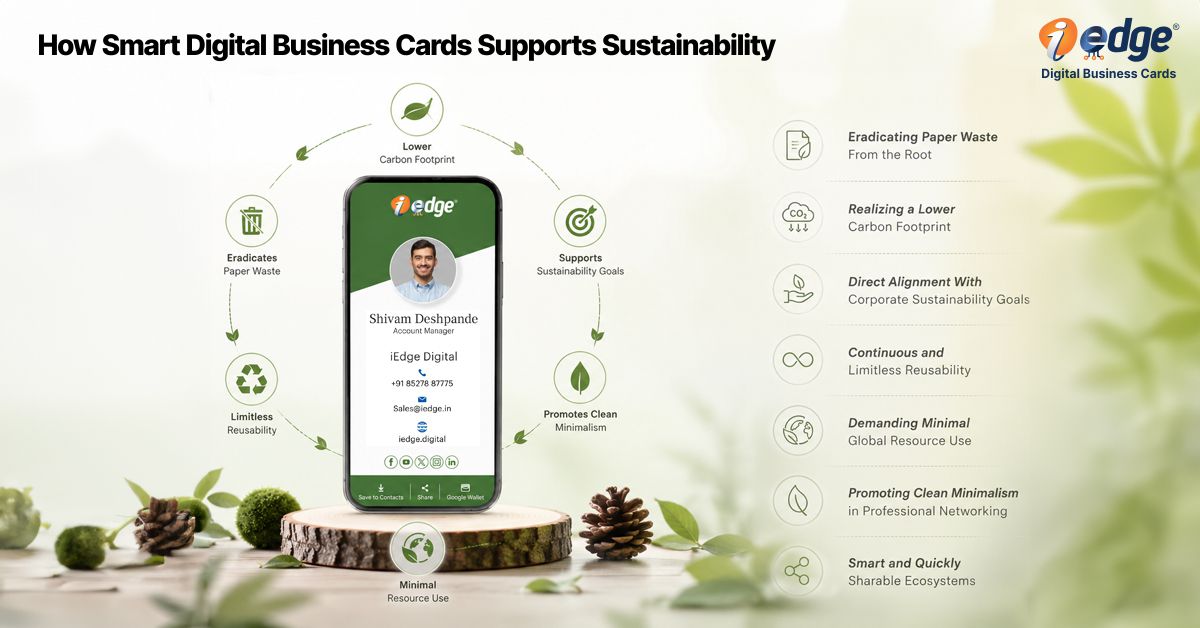
1. Eradicating Paper Waste From the Root
A digital business card for sustainability replaces disposable paper with cloud-based information that can be accessed anytime.
Instead of printing hundreds of cards for every employee, organizations maintain a single digital profile that updates instantly. This simple shift removes paper waste before it is ever created and supports long-term environmental responsibility.


2. Realizing a Lower Carbon Footprint
Unlike printed materials, eco-friendly business cards require no manufacturing, packaging, or shipping every time contact information changes.
Sharing happens digitally through smartphones, QR codes, or links. The absence of repeated production cycles significantly lowers the operational carbon footprint associated with corporate networking activities.
3. Direct Alignment With Corporate Sustainability Goals
Many organizations now publish ESG reports that highlight environmental initiatives and resource conservation efforts.
Implementing sustainable business cards demonstrates measurable action rather than symbolic commitment. It supports waste reduction, digital transformation, and responsible business practices while reinforcing corporate sustainability objectives and green certification programs.


4. Continuous and Limitless Reusability
Digital business cards never become obsolete.
You can update your title, website, phone number, social profiles, or company logo in seconds without placing another print order. Every person who previously saved your card automatically receives access to the latest information.
One digital profile continues delivering value throughout your professional journey.
5. Demanding Minimal Global Resource Use
Digital networking dramatically reduces dependence on paper, ink, water, transportation, and packaging materials.
Organizations adopting virtual credentials eliminate recurring printing cycles while conserving natural resources. The result is a measurable reduction in resource consumption across thousands of employee interactions every year.
The environmental impact of paper business cards becomes far less significant when businesses embrace digital alternatives.


6. Promoting Clean Minimalism in Professional Networking
Modern companies value simplicity, efficiency, and responsible resource management.
Digital sharing reflects those priorities. Instead of exchanging paper that may be misplaced or discarded, professionals exchange organized information that is immediately available on a mobile device.
This approach presents your organization as innovative, environmentally conscious, and technologically advanced. It also represents one of the simplest ways for organizations exploring how to reduce corporate networking waste without disrupting existing sales or networking processes.
7. Smart and Quickly Sharable Ecosystems
Today's professionals expect instant access to information.
Smart business cards allow employees to share contact details through QR codes, NFC technology, email, messaging platforms, or direct links within seconds.
The recipient saves accurate information immediately, reducing manual data entry while creating a faster and more convenient networking experience for both parties.

Why Smart Business Cards Are Better?
Corporate leaders evaluate technology based on scalability, financial value, operational efficiency, and long-term sustainability.
Digital business cards perform well across every category while supporting modern ESG initiatives.
Key advantages include:
- Eliminate recurring printing and shipping expenses across departments.
- Update employee information instantly without replacing physical inventory.
- Scale globally with one centralized platform.
- Support sustainability reporting with measurable waste reduction.
- Improve lead collection through digital sharing methods.
- Present a modern brand image that reflects innovation.
- Reduce storage requirements and administrative overhead.
- Deploy a sustainable and eco-friendly business card for sales team members across multiple regions without additional printing costs.
- Invest in cost-efficient business cards that continue generating value instead of becoming disposable inventory.
For growing organizations, digital networking is both an environmental decision and a strategic financial investment.
Conclusion
Every sustainability initiative begins with practical decisions.
Replacing paper business cards with digital alternatives reduces waste, lowers resource consumption, minimizes carbon emissions, and modernizes your networking strategy. The change requires minimal effort while delivering measurable environmental and financial benefits.
As customers, investors, and employees increasingly value responsible business practices, adopting digital business cards demonstrates that your organization embraces innovation with purpose. Small operational improvements today can help build a greener, smarter, and more sustainable corporate legacy for tomorrow.
FAQs
Digital business cards eliminate paper printing, reduce water consumption, minimize transportation emissions, and prevent unnecessary waste created by outdated physical cards. They help organizations lower their environmental footprint while supporting long-term corporate sustainability initiatives.
Large organizations frequently update employee information. A sustainable and eco-friendly business card for sales team members allows instant updates across every profile without reprinting thousands of cards, reducing waste and operational expenses.
Yes. Businesses eliminate recurring printing, shipping, storage, and redesign costs. Over time, cost-efficient business cards provide substantial savings while supporting digital transformation initiatives.
Yes. Digital business cards reduce paper consumption, lower carbon emissions related to logistics, and decrease resource usage. These measurable improvements support environmental objectives that contribute positively to corporate ESG reporting.
Absolutely. Enterprise organizations benefit from centralized management, instant updates, analytics, and consistent branding across thousands of employees. They also function as cost-efficient business cards that reduce recurring operational expenses while supporting a sustainable and eco-friendly business card for sales team deployment strategy.