
Why Digital Business Cards Are the Future of Networking
Ajay had done everything right.
As a sales lead for a growing technology company, he attended industry events regularly, built relationships with decision-makers, and never missed an opportunity to introduce his company to potential clients.
At one major business conference, he met more than 50 promising prospects in just two days. Conversations were productive, interests aligned, and future meetings seemed inevitable. Like many professionals, Ajay exchanged traditional business cards with everyone he met.
A week later, the excitement faded.
Several prospects never reached out. Some had misplaced his card. Others had intended to contact him but forgot. Meanwhile, Ajay struggled to organize the stack of cards he had collected. Valuable opportunities slipped through the cracks simple because the networking process ended with a piece of paper.
Then came a turning point.
At the next event, Ajay used a digital business card instead. This time, instead of handing out paper cards, he shared a QR code that instantly gave prospects access to his contact details, company profile, website, product brochures, social media links, and meeting scheduler.
The results were dramatically different.
More contacts saved his information. More prospects booked meetings. Follow-ups became easier. Most importantly, Ajay could track engagement and identify interested leads. His networking efforts have become measurable, scalable, and significantly more effective.
Ajay’s experience reflects a larger shift happening across industries today. Traditional networking methods are being replaced by smarter, faster, and more connected alternatives. As businesses embrace digital transformation, digital business cards are emerging as one of the most powerful tools for professional networking.
In this blog, you will learn digital business cards are, why they are becoming essential, how they improve lead generation and branding, and why they represent the future of business networking.
What Are Digital Business Cards?
If you are unfamiliar with digital business cards, let me give you a brief about them.
A digital business card is an electronic version of a traditional paper business card that allows professionals to share contact information digitally through QR codes , NFC technology, direct links, email, text messages, or social platforms.
Unlike paper cards that are limited by size and space, a digital card can contain a lot of information about you such as:
- Contact information
- Company details
- Website links
- Social media profiles
- Product catalog
- Multimedia files
- Portfolios
- Appointment booking links
- Lead capture forms
A digital business card is not simply a replacement for a paper card. It acts as a networking hub that helps professionals connect, engage, and convert prospects more effectively.
Many organizations today use digital business cards as part of their sales enablement, branding, and lead generation strategies because they streamline networking while providing valuable business insights.
The Evolution of Professional Networking
The Era of Traditional Business Cards
For decades, business cards were the cornerstone of professional networking.
Whether at conferences, trade shows, business meetings, or social gatherings, exchanging cards was considered a standard business practice. They served as quick reminders of conversations and provided basic contact information.
While effective in the past, traditional cards, were designed for a business environment that operated differently from today’s digital-first world. Business communication was slower. Networking events were largely in-person. Contact management systems were less sophisticated.
As business evolved, the limitations of paper cards became increasingly apparent.
The Challenges of Traditional Networking
Limited Information
A traditional card typically includes only:
- Name
- Job title
- Phone number
- Email address
- Company name
Modern buyers often want much more information before engaging with a business.
Easy to Lose
Cards frequently get misplaced after networking events. When a card disappears, the opportunity often disappears with it.
Manual Data Entry
Professionals must manually enter contact information into phones or CRM systems, creating inefficiencies and increasing the likelihood of errors.
Costly Updates
Any Change in contact details, branding, or job role requires reprinting.
No Performance Tracking
Perhaps the biggest limitation is the inability to measure results. Traditional cards provide no insight into whether recipients are engaged with your information.
Why Networking Has Become Digital
The rise of smartphones, cloud technology, remote work, and hybrid business environments has transformed how professionals connect.
Today’s networking expectations include:
- Instant communication
- Mobile accessibility
- Contactless sharing
- Real-time updates
- Personalized experiences
People no longer want to collect stacks of paper. They want immediate access to information that helps them make decisions. Digital networking addresses these expectations perfectly.
Whether meeting someone at a conference, connecting through LinkedIn, participating in a webinar, or attending a virtual event, professionals now expect seamless digital experiences. Digital business cards are at the center of this transformation.
Top Benefits of Digital Business Cards
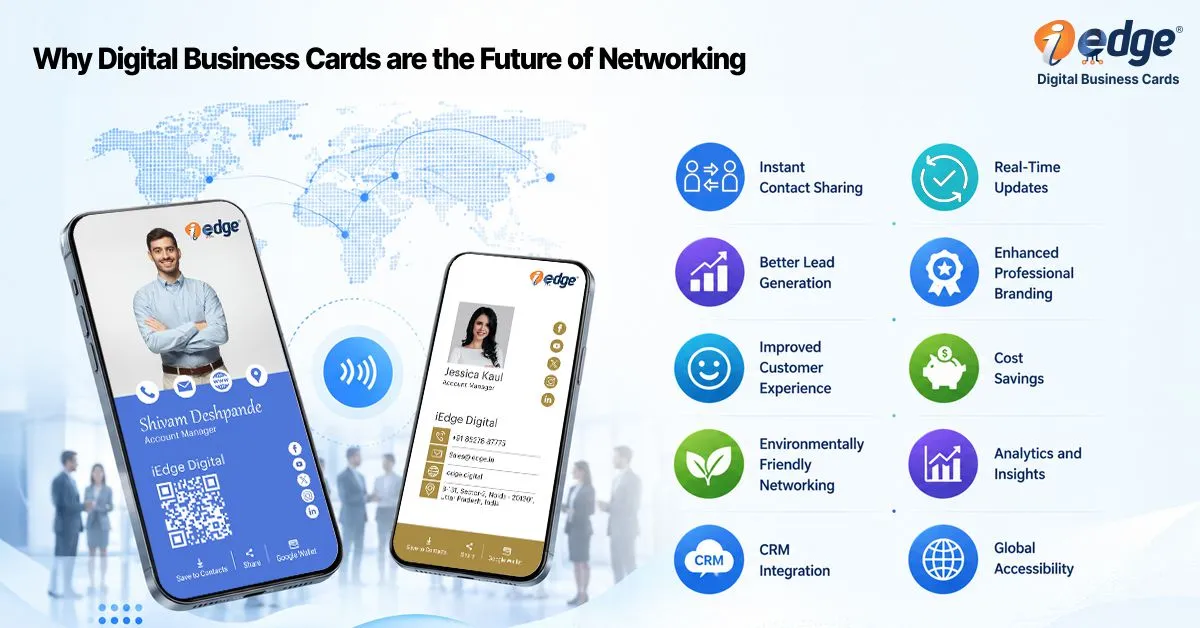
1. Instant contact Sharing
Speed matters in modern networking.
When professionals exchange information, they want th process to be quick and frictionless. A digital business card allows users to share their complete professional profile within seconds through a QR code, NFC business Card, or direct link.
Instead of manually typing information, recipients can instantly save details to their phones. This convenience significantly improves networking efficiency and reduces the chances of losing valuable connections.

2. Real-Time Updates
One of the most powerful advantages of a digital business card is the ability to update information instantly.
Imagine changing:
- Your phone number
- Company address
- Website URL
- Job Title
- Social media profiles
With traditional cards, these changes require reprinting. With a digital business card, updates happen instantly and are reflected everywhere the card is shared. This ensures contacts always have accurate information.
3. Better Lead Generation
Traditional cards are passive. Digital business cards are active lead generation tools.
Many platforms include:
- Contact forms
- Lead capture features
- CRM integration
- Automated workflows
Instead of simply sharing contact details, businesses can collect prospect information and move them directly into the sales pipeline. This transforms networking into a measurable revenue-generating activity.


4. Enhanced Professional Branding
First impressions matter. A digital business card provides opportunities to showcase your brand far beyond basic contact information.
You can include:
- Company logo
- Brand colors
- Promotional videos
- Product demonstrations
- Case studies
- Customer testimonials
These elements create a richer and more memorable experience that strengthens brand perception.
5. Improved Customer Experience
Modern buyers expect convenience. A digital business card removes unnecessary steps and allows prospects to access information immediately. Instead of searching online for your website or LinkedIn profile, recipients can access everything from a single location.
This creates a smoother customer journey and increases engagement.


6. Cost Savings
Businesses spend considerable resources on printing, redesigning, and distributing traditional cards. Digital business cards eliminate recurring printing expenses while providing greater functionality.
For organizations with large sales teams, the savings can be substantial over time.
7. Environmentally Friendly Networking
Sustainability is becoming increasingly important to businesses and consumers alike. Every year, millions of paper business cards are printed, many o which are discarded shortly after distribution.
Digital business cards reduce paper consumption and support environmentally responsible business practices. Organizations pursuing sustainability goals can align networking efforts with broader ESG initiatives.


8. Analytics and Insights
Unlike traditional cards, digital business cards provide measurable insights.
Users can often track:
- Profile views
- Link clicks
- Content downloads
- Contact saves
- User engagement
These analytics help professionals understand which networking activities generate the best results.
9. CRM Integration
Sales teams rely heavily on CRM systems to manage customer relationships. Many digital business card solutions integrate directly with popular platforms, allowing leads to flow automatically into the sales process.
Benefits include:
- Reduced manual work
- Fater follow-ups
- Better lead management
- Improved sales productivity


10. Global Accessibility
Business today is no longer limited by geography. Whether networking with someone across the room or across the world, a digital business card can be shared instantly.
This makes it an ideal solution for remote teams, international organizations, consultants, and global sales professionals.
How Digital Business Cards Turn Networking into Revenue
Many professionals view networking as relationship-building. Successful businesses view networking as a revenue opportunity. The difference often comes down to the tools being used.
Traditional Networking Workflow
- Exchange cards.
- Collect paper contacts.
- Return to the office.
- Organize information manually.
- Attempt follow-ups.
This process creates delays and increases the risk of losing leads.
Digital Networking Workflow
- Share digital business card.
- Prospects access profile instantly.
- Contact information is captured automatically.
- CRM receives lead data
- Automated follow-ups begins.
The process becomes significantly faster and more efficient. Sales teams can identify interested prospects sooner, personalize outreach, and accelerate conversions.
This is one reason why digital business cards are increasingly viewed as strategic lead generation tools rather than simple networking assets.
Why Your Business Card Is Also a Branding Asset
Many organizations underestimate the branding potential of their business cards. A traditional card offers limited space and limited creativity. A digital business card becomes an extension of your brand experience.
Showcase Your Brand Story
Businesses can communicate their value proposition through:
- Videos
- Product Showcases
- Company overviews
- Success stories
Build Trust Faster
Trust is critical in modern buying decisions.
Digital business cards can include:
- Testimonials
- Awards
- Certifications
- Case Studies
These assets help establish credibility immediately.
Create Consistent Brand Experiences
Organizations can ensure every employee shares the same branded experience, strengthening corporate identity and professionalism.
Digital Business Card vs Traditional Business Cards
| Feature | Traditional Business Cards | Digital Business Cards |
|---|---|---|
| Contact Sharing | Manual | Instant |
| Information Updates | Reprinting Required | Real-Time |
| Multimedia Support | No | Yes |
| Lead Capture | Limited | Advanced |
| Analytics | No | Yes |
| CRM Integration | No | Yes |
| Environmental Impact | High | Low |
| Global Accessibility | Limited | Unlimited |
| Cost Efficiency | Moderate | High |
| Branding Potential | Limited | Extensive |
Industry Use Cases for Digital Business Cards
1. Sales Teams
Sales representatives use digital business cards to capture leads instantly and improve follow-up efficiency.
2. Real Estate Professionals
Agents can share property portfolios, virtual tours, and contact information through a single digital profile.
3. Consultants
Consultants can showcase expertise, client success stories, and servie offerings more effectively.
4. Startups
Startup founders benefit from easier investor networking and partnership development.
5. Healthcare Professionals
Doctors, specialists, and healthcare consultants can simplify professional networking while sharing credentials and practice information.
6. Freelancers
Freelancers can display portfolios, testimonials, and project examples to attract new clients.
How Digital Business Cards Support the Modern Marketing Funnel
Digital business cards contribute to every stage of the customer journey.
1. Awareness Stage
Prospects discover your brand through events, referrals, webinars, or networking opportunities. A digital business card provides instant access to relevant information.
2. Consideration Stage
Prospects evaluate solutions.
Digital cards can deliver:
- Case studies
- Product information
- Customer success stories
- Brochures
3. Decision Stage
Prospects are ready to act.
Digital business cards simplify actions through:
- Appointment scheduling
- Direct calling
- Contact forms
- Website access
This reduces friction and improves conversion rates.
The Future of Digital Networking
The future of networking extends far beyond simply replacing paper cards.
- AI-Powered Networking: Artificial intelligence will help professionals identify high-value opportunities, recommend connections, and personalize engagement strategies.
- Predictive Lead Scoring: Future platforms may automatically identify the most promising prospects based on engagement based on engagement patterns.
- Automated Follow-Ups: Intelligent systems will trigger personalized follow-up sequences based on prospect behavior.
- Augmented Reality Experiences: AR technology could enable immersive product demonstrations directly from a digital business card.
- Deeper CRM Integration: Professionals will manage their complete digital identities through centralized networking platforms that connect contacts, content, communication, and analytics.
These developments further reinforce why digital business cards represent the future of professional networking.
Conclusion
The story of Ajay reflects a reality that many businesses face today.
Traditional networking methods often fail to support the speed, efficiency, and expectations of modern professionals. Lost cards, missed follow-ups, outdated information, and limited engagement make paper-based networking increasingly ineffective.
Digital business cards solve these challenges by combining contact sharing, branding, lead generation, analytics, and automation into a single networking solution.
They help professionals create stronger first impressions, capture more opportunities, streamline follow-ups, and build lasting business relationships.
As organizations continue investing in digital transformation, the shift toward digital networking will only accelerate.
The future of networking is not about collecting stacks of paper cards. It is about creating meaningful, measurable, and scalable connections.
Businesses that embrace digital business cards today will be better positioned to generate leads, strengthen relationships, and stay competitive in an increasingly digital world.
Frequently Asked Questions
Digital business cards use technologies such as QR codes, NFC, and direct URLs to share information instantly. Recipients can access contact details, websites, portfolios, and other resources directly from their smartphones without requiring manual data entry.
Most reputable platforms offer security features including encryption, access controls, and privacy settings to protect user data. Businesses should evaluate security standards before selecting a provider.
Yes, iEdge allows recipients to access information through web browsers, making sharing simple and accessible without requiring app downloads.
An NFC business card uses Near Field Communication technology to transfer information when tapped against a compatible smartphone. It provides a fast and contactless networking experience.
Virtually every industry can benefit, including sales, real estate, consulting, healthcare, technology, finance, education, and professional services.